The AI Winters Weren't a Failure. They Were a Training Run.
AI nearly died twice. The funding collapses of the 1970s and late 1980s forced the field to drop what couldn't scale and keep what could. Here's what each winter taught, with code you can run.
Twice in its history, artificial intelligence nearly died. Funding vanished, labs shrank, and researchers learned to keep the words artificial intelligence out of their grant proposals. We call these periods the AI winters.
It’s tempting to read them as embarrassing detours on the road to today’s models. That gets the story backwards. The winters behaved like a brutal training run for the field itself: high loss, painful gradients, and in the end, weights that actually generalise. Most of what works in modern AI was either discovered during a winter, or survived one because it deserved to.
#What an AI winter actually is
An AI winter is a stretch of years when funding and interest in AI collapse after a cycle of inflated expectations. The term was coined in 1984, at a public debate at the annual meeting of the AAAI, where Roger Schank and Marvin Minsky warned that enthusiasm for AI had run far ahead of what it could deliver, and that disappointment would follow. Within three years, it did.
#The first winter (c. 1974–1980): promises meet combinatorics
#The promise
The field was founded on optimism. The 1956 Dartmouth workshop proposal conjectured that “every aspect of learning or any other feature of intelligence can in principle be so precisely described that a machine can be made to simulate it.” In 1965, Herbert Simon predicted that “machines will be capable, within twenty years, of doing any work a man can do.”
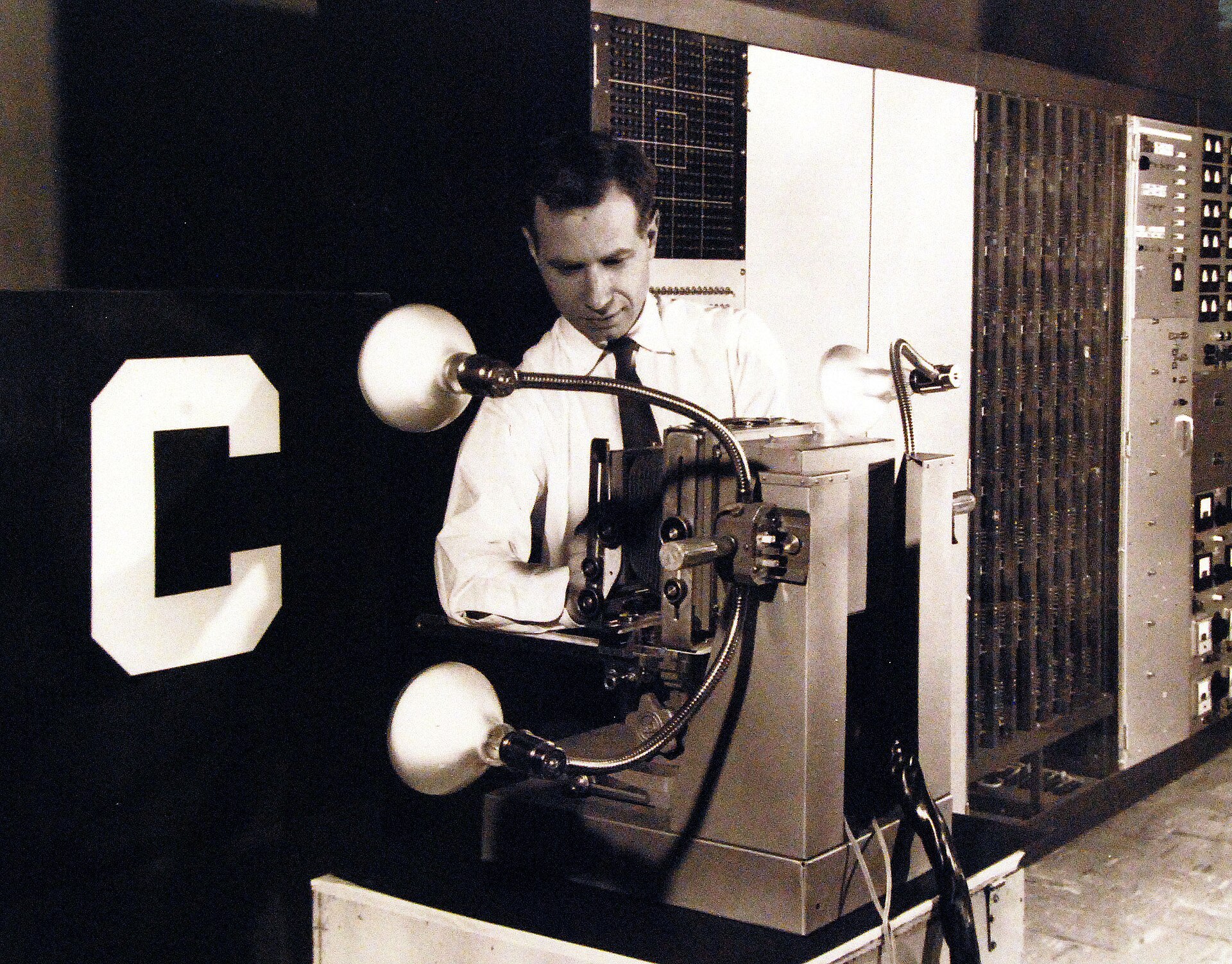
The hardware seemed to agree. Frank Rosenblatt’s perceptron, demonstrated in 1958, learned to recognise simple patterns from examples instead of following hand-written instructions. The press treated it as the first step towards machines that could think. The pictures on this page tell the story of the field in three machines; the perceptron at the top is the first.
#What broke
- Machine translation. In 1966 the US government’s ALPAC report concluded that machine translation was slower, less accurate and more expensive than human translation. Funding for it largely dried up.
- Perceptrons. In 1969, Marvin Minsky and Seymour Papert’s book Perceptrons showed that a single-layer perceptron cannot represent some very simple functions, the most famous being XOR. Multi-layer networks could, but nobody had a practical way to train them. Neural-network research went quiet for over a decade.
- The Lighthill Report. In 1973, Sir James Lighthill reviewed AI for the UK’s Science Research Council and concluded that “in no part of the field have the discoveries made so far produced the major impact that was then promised.” His diagnosis was the combinatorial explosion: methods that worked on toy problems drowned in possibilities on real ones. British AI funding was cut back sharply.
- DARPA. After the 1969 Mansfield Amendment pushed military research towards work with direct applications, and after a disappointing speech-understanding programme (1971–1976), DARPA stopped funding open-ended AI research.
#The XOR problem in a few lines
The perceptron objection is easy to reproduce. XOR outputs 1 when exactly one input is on. Plot the four inputs on a square and the two 1s sit on opposite corners, so no single straight line can separate them, and a perceptron is exactly one straight line. However long you train it, it can’t get all four right:
import numpy as np

X = np.array([[0, 0], [0, 1], [1, 0], [1, 1]], dtype=float)
y = np.array([0, 1, 1, 0], dtype=float)  # XOR: true when exactly one input is on

# Rosenblatt's perceptron: a single linear decision boundary.
w, b = np.zeros(2), 0.0
for epoch in range(1000):
    for xi, yi in zip(X, y):
        pred = float(xi @ w + b > 0)
        w += (yi - pred) * xi
        b += yi - pred

print("perceptron:", [int(xi @ w + b > 0) for xi in X])
# Never [0, 1, 1, 0]: no single straight line separates XOR.perceptron: [1, 1, 0, 0]The target is [0, 1, 1, 0]. That gap between the target and what one line can draw is what Minsky and Papert formalised, and it took the field 17 years to answer it in practice.
#The second winter (c. 1987–1993): rules meet the real world
AI came back in the early 1980s as expert systems: programs that encoded a specialist’s knowledge as hundreds or thousands of if-then rules. At first they worked. Digital Equipment Corporation’s XCON configured customer orders for VAX computers and was reported to save the company tens of millions of dollars a year. Corporations set up AI departments. Japan launched its Fifth Generation Computer project in 1982, and DARPA answered with the Strategic Computing Initiative in 1983.
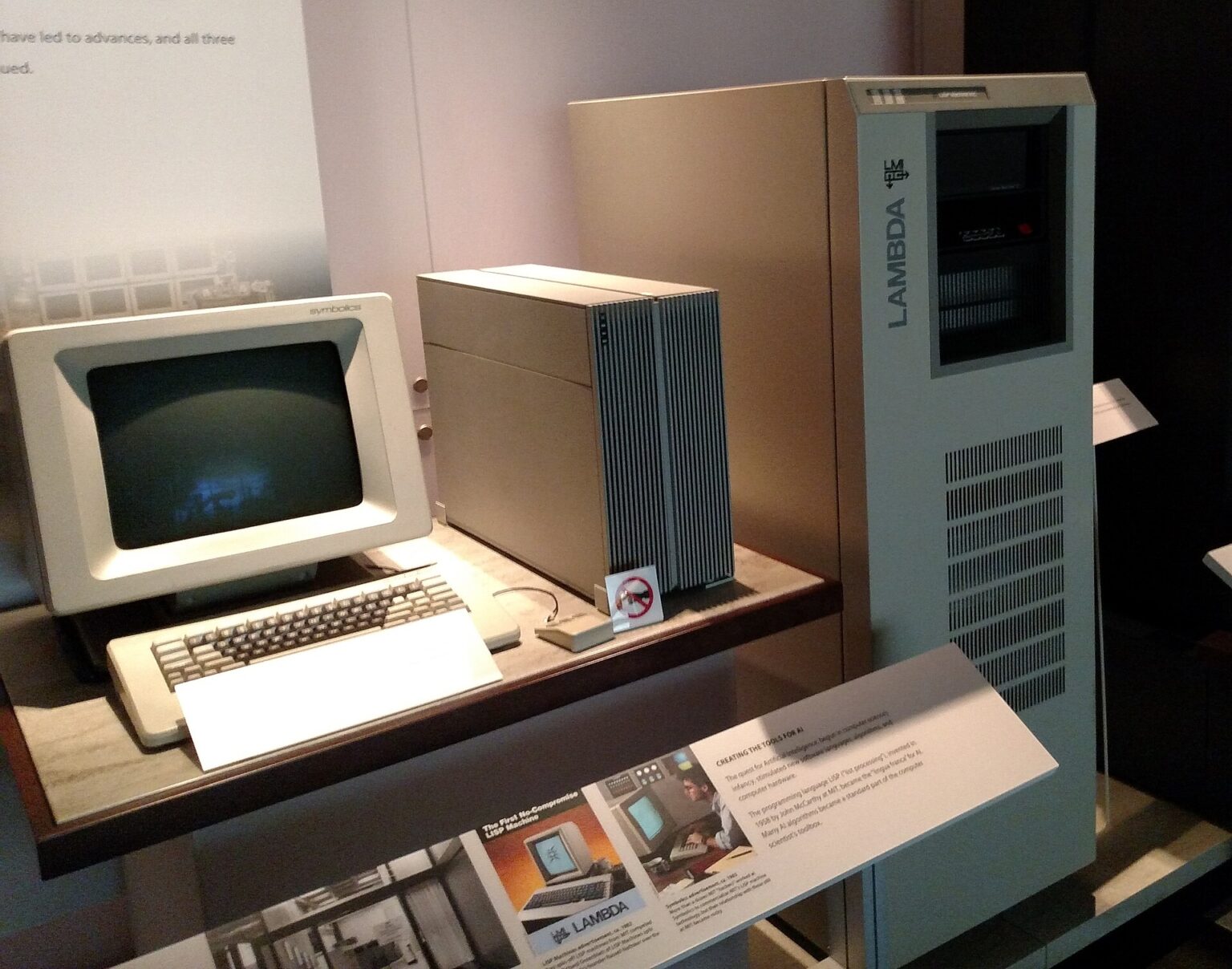
A whole hardware industry grew around the boom: Lisp machines, workstations designed to run the language most AI was written in.

#What broke
- Brittleness. Rules covered the cases their authors thought of. Step slightly outside the domain and an expert system failed badly, with no way of knowing it was out of its depth.
- Maintenance. Every new edge case meant another hand-written rule, and rules interacted in ways nobody could predict. Systems like XCON grew to thousands of rules and needed dedicated teams just to keep them working.
- The knowledge bottleneck. Getting expertise out of experts’ heads and into rules was slow and expensive, and it didn’t get cheaper with scale.
- Hardware. In 1987 the market for specialised Lisp machines collapsed. General-purpose workstations and PCs had become fast enough, and far cheaper.
- The big programmes ended short of their goals. The Strategic Computing Initiative was cut back at the end of the 1980s, and the Fifth Generation project wound down in 1992.
#Why the winters were necessary
Here’s the argument. Each winter removed something that couldn’t scale, and protected something that could.
#1. They killed what couldn’t scale
Both booms bet on people writing intelligence down: as symbolic search in the 1960s, and as hand-written rules in the 1980s. Both hit the same wall, because the world has more cases than anyone can enumerate. The winters made that lesson expensive enough to stick. What replaced it was learning from data, the idea Rich Sutton later summed up as the bitter lesson:
The biggest lesson that can be read from 70 years of AI research is that general methods that leverage computation are ultimately the most effective, and by a large margin.
Rich Sutton, The Bitter Lesson (2019)
#2. They forced rigour
With money scarce, “it works in the demo” stopped being enough. Through the late 1980s and 1990s the field rebuilt itself on mathematics and measurement: Judea Pearl’s probabilistic reasoning (1988), statistical learning theory and support vector machines (Cortes and Vapnik, 1995), hidden Markov models in speech recognition, and shared benchmarks scored on held-out test data. Many researchers avoided the label “AI” altogether and called their work machine learning, pattern recognition or data mining.
If you split your data into train, validation and test sets and distrust any result you can’t reproduce, you’re using habits the field learned in the cold.
#3. They filtered for conviction
A funding collapse is a crude filter, but it does one thing well: the people who stay are the ones who believe the problem is real. Neural networks survived on a small group of them:
- 1986: Rumelhart, Hinton and Williams popularise backpropagation, a practical way to train multi-layer networks. That was the answer to Minsky and Papert’s objection.
- 1989: Yann LeCun’s convolutional networks learn to read handwritten ZIP codes. By the late 1990s, CNN-based systems were reading cheques in production.
- 1997: Hochreiter and Schmidhuber publish the LSTM, the architecture behind a generation of speech and translation systems.
- 2004: CIFAR, a Canadian research institute, funds Geoffrey Hinton’s neural-computation programme when very few others would.
Add one hidden layer and train it with backpropagation, and the problem that helped freeze the field in 1969 falls over in a few thousand steps:
import numpy as np

X = np.array([[0, 0], [0, 1], [1, 0], [1, 1]], dtype=float)
y = np.array([0, 1, 1, 0], dtype=float)

rng = np.random.default_rng(0)
W1, b1 = rng.normal(size=(2, 8)), np.zeros(8)  # one hidden layer, 8 units
W2, b2 = rng.normal(size=(8, 1)), np.zeros(1)

def sigmoid(z):
    return 1 / (1 + np.exp(-z))

for step in range(5000):
    # forward pass
    h = np.tanh(X @ W1 + b1)
    p = sigmoid(h @ W2 + b2).ravel()

    # backward pass: gradients of the binary cross-entropy loss
    dz2 = (p - y)[:, None] / len(X)
    dW2, db2 = h.T @ dz2, dz2.sum(axis=0)
    dh = (dz2 @ W2.T) * (1 - h**2)
    dW1, db1 = X.T @ dh, dh.sum(axis=0)

    # gradient descent
    for param, grad in ((W1, dW1), (b1, db1), (W2, dW2), (b2, db2)):
        param -= 1.0 * grad

print("two-layer net:", (p > 0.5).astype(int).tolist()) # [0, 1, 1, 0]two-layer net: [0, 1, 1, 0]Across 100 random initialisations, this network solved XOR every time.
#4. They made the field wait for data and compute
Most of the ideas behind deep learning were in place by the late 1990s. What was missing was data and computation. ImageNet (2009) supplied the data: its annual challenge came with 1.2 million labelled training images. Gaming graphics cards supplied cheap parallel arithmetic.
In 2012, AlexNet, a convolutional network trained on two NVIDIA GTX 580 cards, won the ImageNet challenge with a top-5 error of 15.3%, against 26.2% for the runner-up. Spring had arrived, and it was built almost entirely from ideas that had survived the cold.


#The two winters at a glance
| First winter (c. 1974–1980) | Second winter (c. 1987–1993) | |
|---|---|---|
| The bet | General problem-solving by search and logic; single-layer perceptrons | Expert knowledge as hand-written rules, on specialised Lisp hardware |
| Why it broke | Combinatorial explosion; perceptrons couldn’t learn XOR; translation failed | Brittle, costly to maintain; general-purpose hardware got cheaper |
| What survived | Search and heuristics, knowledge representation, the question of how to train deeper networks | Probabilistic reasoning, statistical machine learning, backpropagation, CNNs, rigorous benchmarks |
#Are we heading for a third winter?
Every boom invites the question. Two things are different this time. Today’s systems already deliver value at scale, in search, translation, code, speech and vision, which neither earlier boom ever did. And the methods that drive them are the ones that survived both winters, not the ones that caused them.
The old warning signs are still worth watching for, though: promises measured in years until human-level AI, economics that only work if adoption keeps accelerating, and progress judged by demos instead of held-out evaluations. If the winters taught anything, it’s that the correction lands on the gap between what was promised and what was delivered, not on the technology itself. Close the gap, and there’s nothing for a winter to punish.
The practitioner’s version of the lesson: ship evaluations, not demos. Measure on data the model hasn’t seen, publish the failure cases, and scope every claim to what you actually measured.
#Takeaways
- The winters removed approaches that couldn’t scale, like hand-written knowledge, and kept the one that could: learning from data.
- Scarcity forced statistics, benchmarks and honest evaluation, which are still the backbone of machine learning.
- The core ideas of deep learning, including backpropagation, CNNs and LSTMs, were developed or kept alive through the cold.
- Progress waited on data and compute as much as on ideas.
- The best insurance against the next winter is keeping what we promise close to what we can measure.
#Further reading
- Artificial Intelligence: A General Survey, James Lighthill (1973). The report behind the first British winter.
- Perceptrons, Marvin Minsky and Seymour Papert (1969).
- Learning representations by back-propagating errors, Rumelhart, Hinton and Williams, Nature (1986).
- ImageNet Classification with Deep Convolutional Neural Networks, Krizhevsky, Sutskever and Hinton (2012). The AlexNet paper.
- The Bitter Lesson, Rich Sutton (2019).
- AI winter on Wikipedia, a good map of the whole history.
#Image credits
Cover: the Mark I Perceptron, U.S. Navy photo from the National Museum of the U.S. Navy, public domain. Other images are credited in their captions.
